
Not that long ago, getting someone to your website was the whole game. Rank high, earn the click, convert the visitor. The funnel was simple, if not always easy. You could measure it, optimize it, report on it in a monthly deck.
That model is breaking down. And for a lot of brands, it’s already broken.
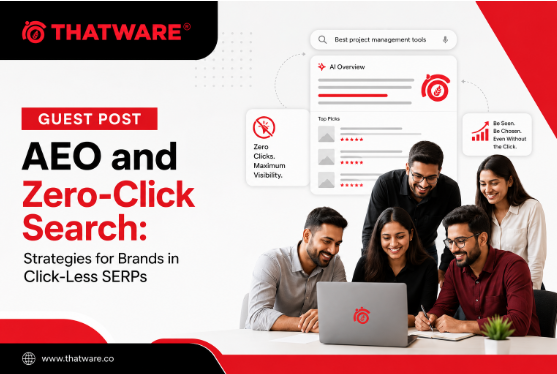
Zero-click search — where users get their answer directly in the SERP or from an AI assistant without ever visiting a website — has been growing steadily for years. But the emergence of AI-powered answer engines has accelerated it dramatically. When someone asks Google’s AI Overview or ChatGPT a question, they often get a complete, actionable answer. No click required. Which means the website that would have gotten that traffic? It doesn’t.
This isn’t a minor inconvenience. For some categories, it’s an existential shift.
Why Zero-Click Isn’t Going Away
There’s a tempting narrative that this is temporary — that AI search will evolve to send more traffic, that users will eventually want to go deeper, that the click will return. Maybe. But betting your brand’s visibility on that assumption seems unwise given the trajectory.
The more realistic view is that zero-click search is the new baseline for a large and growing portion of informational and research queries. The brands that adapt — that figure out how to build authority and visibility in an environment where clicks aren’t the currency — are the ones that will maintain market presence. The ones that keep optimizing for a click that may not come are going to fall behind.
That’s the core tension that AEO vs SEO comparisons are really about. Traditional SEO optimizes for ranking and clicks. Answer Engine Optimization optimizes for inclusion — being the source, the reference, or the brand that gets named when an AI constructs its response. Those are different goals, requiring different strategies.
What “Brand Presence Without Clicks” Actually Looks Like
The shift here is one of framing. In a zero-click world, visibility isn’t about getting someone to your website — it’s about getting your brand, your name, your positioning into the answer itself. When an AI says “According to [Your Company], the best approach is…” or “Brands like [Your Company] are known for…” — that’s a win even if nobody clicked anything.
This is a genuinely different kind of value, and it requires a different kind of measurement. Share of voice in AI answers. How often your brand name appears in relevant AI outputs. Whether your core messages are being reflected accurately in AI-generated content. These are the new metrics that matter in a zero-click landscape.
Building toward those metrics means creating content that is explicitly designed to be cited — clear, authoritative, well-structured, and directly responsive to the questions your audience is asking. It means building the external validation signals that make AI systems willing to reference your brand by name. And it means thinking about your brand positioning not just as something users encounter on your website, but as something that needs to exist in the broader digital knowledge graph.
The Attention Economy Reframe
Here’s a way to think about zero-click search that actually makes it less threatening. In a world where attention is scarce, getting your brand into the answer that someone receives — even if they don’t click — is still a form of brand exposure. It’s awareness. It’s positioning. It’s your message reaching someone at the exact moment they’re thinking about the problem you solve.
That’s not nothing. In fact, for brand awareness goals, it might be more valuable than a click to a landing page they bounce off in twelve seconds.
The brands that will thrive in zero-click environments are the ones that treat AI answer inclusion as a legitimate marketing channel — not a consolation prize for not getting the click. Building a strategy around Answer Engine Optimization services means accepting that the definition of “being found” is changing, and investing in the kind of visibility that works in the new paradigm.
Practical Strategies for Zero-Click Environments
A few things that actually move the needle for brands navigating this shift:
Answer-first content design. Stop burying your key insights three paragraphs deep. Put the direct, clear answer to each question at the top, then elaborate. AI systems are designed to extract answers efficiently — they favor content that makes that easy.
Entity building. Make sure that the “digital entity” that represents your brand is coherent across the web. Consistent descriptions, accurate categorizations, reliable factual signals. The more confidently an AI can “understand” your brand, the more likely it is to reference it.
Third-party citation development. Get your brand, your statistics, your frameworks cited by credible external sources. AI systems are much more willing to name brands that appear to have earned external recognition.
Zero-click is uncomfortable territory for brands that built their entire strategy around web traffic. But it’s also genuinely open territory — the AEO playbook is still being written, and the brands that move now will help write it.